Block Puzzle
- 4.5
- Rating
- 10.00M
- Installs
- Free
- Price
 Analysis by App-foxy
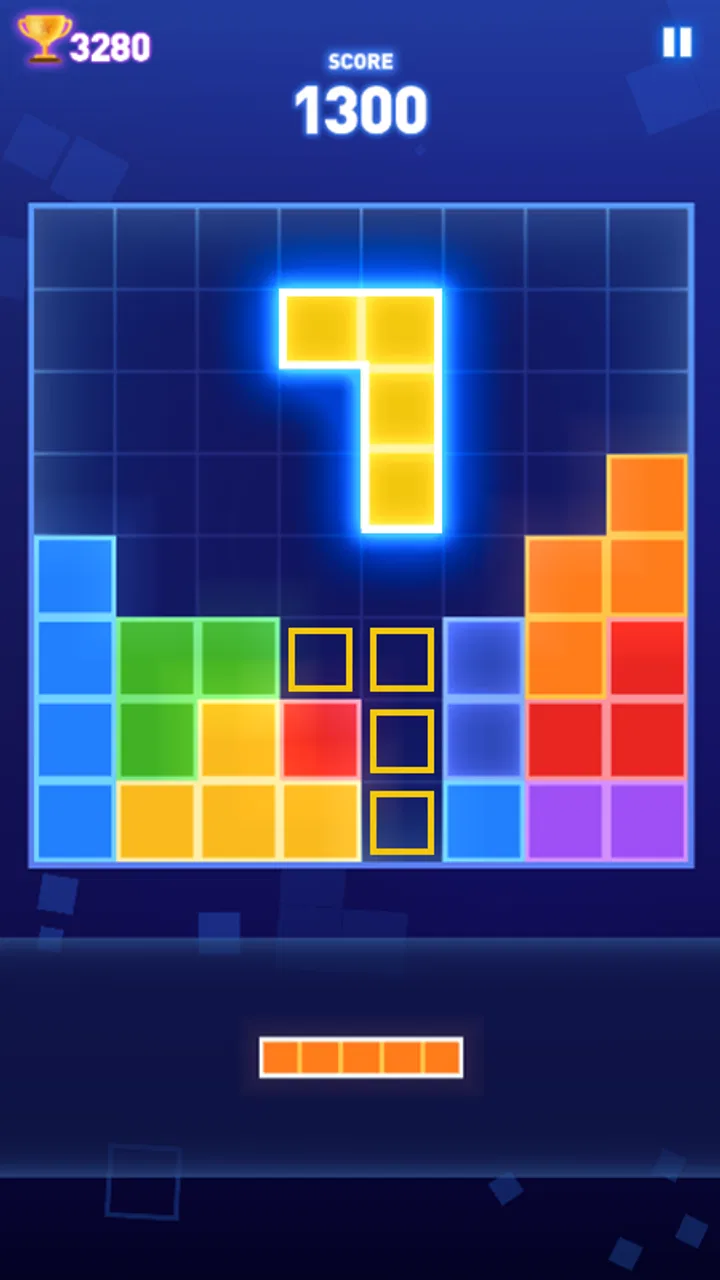
I approached Block Puzzle expecting a quick, familiar puzzle game, and that is exactly where its appeal lies. Developed by Candy Mobile, this free Android game keeps the central idea easy to understand: place blocks carefully, complete lines, and keep the board from becoming unusable. There is no complicated story to learn or large set of rules to memorize, so I could start playing almost immediately.
That simplicity makes it a comfortable choice for short sessions. I can open it when I have a few quiet minutes, play at my own pace, and stop without feeling that I have abandoned a long quest. At the same time, the open-ended board creates enough tension to make each placement matter. The game is not difficult because it hides instructions; it is difficult because a harmless-looking move can remove the space needed for the next useful block.
How the first few sessions establish the game’s goals
The early objective is clear from the first board: build complete lines while preserving room for future pieces. That sounds basic, but it gives every move a small decision attached to it. I quickly learned that filling a gap immediately is not always the best choice. Sometimes leaving an awkward space open is wiser if it keeps several areas available for later shapes.
You May Also Like

 Blood Strike: 2.5 Anniversary
Blood Strike’s Loadouts Turn Every Drop Into a Tactical Gamble
A close look at Blood Strike’s custom loadouts: how fast access to signature weapons reshapes its battle royale rhythm, rewards preparation, and narrows the gap between fights.

 Pandora - Music & Podcasts
Pandora’s Music Is Easy to Start, but Harder to Recover
Pandora’s strength is its low-effort path from a seed to a station. Its weak spot is how much confidence it asks you to place in connection, setup, and quiet recovery.

 8 Ball Pool
 Is Built on Rivalries, Rematches, and Routine
A close look at the rivalries, rematches, shared routines, and unanswered safety questions that turn a quick pool match into a persistent mobile community.

 Samsung Music
’s Quiet Strength Is Playing What You Already Own
Its reach comes less from spectacle than from dependable access to a personal library. That simplicity is both the app’s strongest retention engine and its ceiling.

 AccuWeather: Weather Radar
AccuWeather Review: A Quick, Clear Forecast for Everyday Decisions
For everyday plans, the best forecast is the one you can understand quickly. AccuWeather makes rain timing, radar, and local conditions easy to act on, with a few trade-offs.

 Hill Climb Racing
Why Hill Climb Racing Still Turns Crashes Into One More Run
A tiny car, a bumpy hill and one more upgrade: Hill Climb Racing keeps resurfacing because its simple chaos makes every near-miss feel personal.
More From Our News Desk



This is where the game’s early pacing works well. It does not ask me to understand a deep progression system before I can enjoy it. Instead, the first goals come directly from the board in front of me. Clear a line, create more room, and avoid trapping the next pieces. The feedback is immediate, which makes the opening minutes accessible even for someone who does not usually play puzzle games.
The lack of a complicated introduction is also useful for younger players. The content rating is Everyone, and the straightforward rules are easy to explain to someone else. I could hand the device to a casual player without needing to describe characters, energy systems, or a long sequence of tutorials. The challenge comes from spatial planning rather than from reading a lot of text.
Still, players looking for a strong narrative goal should adjust their expectations. This is a board-focused puzzle experience, not an adventure with story chapters or character development. Its motivation comes from improving decisions and surviving longer, so it suits people who enjoy repeating a simple system and gradually becoming more careful with it.
What counts as progress when there is no elaborate journey
In a game this stripped back, progress is mostly personal. I notice it when I recognize a dangerous placement earlier than before, when I stop wasting open space, or when I recover from a crowded board instead of reacting too late. The board itself becomes the progress signal: a clean layout feels controlled, while a board with scattered gaps warns me that my options are narrowing.
That kind of feedback is subtle, but it is satisfying. I do not need a new character or a new map to see improvement. A better run usually comes from making fewer short-term decisions. I began to think in terms of keeping several possible placements available rather than simply choosing the first place where a block fit.
One useful habit is to examine all the current pieces before placing any of them. The most obvious move may be safe for one shape but harmful for the group. If one piece has an unusual form, I try to reserve the most suitable open area for it first. This small change in workflow makes the game feel more strategic without adding any complicated rule.
Another practical tip is to treat empty space as a resource. Players often focus on completed lines because they provide the visible reward, but the remaining gaps determine whether the next turn is manageable. I get better results when I avoid dividing the board into disconnected pockets. A compact, flexible layout gives me more ways to respond to awkward pieces.
These observations are where the game offers more depth than its short description suggests. The rules are simple, but the board rewards planning several placements ahead. It is not a puzzle that tells me exactly what to solve; it gives me a changing arrangement and asks me to protect my future options.
The difficulty curve comes from space, not from a complicated rulebook
The challenge develops naturally because every placement changes the shape of the board. Early moves usually feel forgiving, since there is plenty of room to experiment. Later, the consequences become sharper. A single poorly positioned block can leave a narrow cavity that is difficult to use, and several such cavities can make the next pieces much harder to place.
I like this form of difficulty because it does not depend on rushing me. The pressure comes from making a board that is increasingly restrictive. I can take a moment to inspect the situation, but thinking time does not remove the underlying problem. If I have already damaged the layout, careful observation may only help me delay the inevitable.
The best way to handle the middle of a run is to avoid chasing every immediate line clear. A line that disappears now can be less valuable than a placement that keeps the board open. I often ask myself which move leaves the most useful shapes of empty space afterward. That question is more reliable than simply choosing the move that produces the quickest visible result.
There is also a trade-off between tidy play and emergency play. A neat board is easier to manage, but real runs rarely stay perfect. When the layout becomes crowded, I look for the move that restores flexibility, even if it does not clear a line immediately. This can mean accepting an imperfect arrangement temporarily so that a later piece has somewhere to go.
Players who prefer clearly staged levels may find this less satisfying than a traditional match-three game with defined objectives. In those alternatives, the difficulty is often communicated through a level target, a limited number of moves, or a new obstacle. Here, the board’s condition is the main measure of danger, so the experience feels more like maintaining balance than completing a checklist.
Why the simple loop can keep me playing
The retention appeal is easy to understand: each run offers a chance to make a cleaner set of decisions than the previous one. Because the basic loop is quick to grasp, I do not spend time rebuilding knowledge before trying again. A failed board is not a complicated setback; it is an invitation to identify the move where my planning became too narrow.
That makes it useful in everyday situations. I find it suitable for a short break, a quiet wait, or a few minutes before going to sleep, especially when I want something more engaging than scrolling but less demanding than a story-heavy game. The session structure feels flexible because the game does not require me to remember a plot or coordinate with other players.
At the same time, the same replayability can become repetitive. The pleasure depends heavily on whether I enjoy refining decisions inside one central puzzle format. If I need constant novelty, collectible rewards, changing environments, or a sense of unlocking a larger world, this may feel limited after the initial curiosity wears off.
I would also avoid treating it as a relaxing game in every situation. The controls and rules are approachable, but a crowded board can become surprisingly tense. When I am trying to preserve space, I am still making consequential choices, even though the presentation is simple. It is calm in pace, not necessarily effortless in concentration.
One way I keep the experience fresh is to change the goal of a session. Instead of always trying to extend a run, I might focus on maintaining a balanced board, avoiding isolated gaps, or practicing patience before placing a tempting piece. These self-imposed targets give the familiar loop a different emphasis without pretending that the game has a large collection of separate modes.
Small decisions that separate a good run from a messy one
The most important lesson I took from playing is to delay commitment when possible. If several pieces are available, I avoid immediately filling the largest open area. Large spaces are valuable because they can accept more shapes, while small spaces are often suitable for only one or two possibilities. Spending a flexible area too early can leave me with nowhere to place a less convenient block.
I also try to keep the board’s height under control. A tall stack may not look dangerous if it leaves a broad empty section elsewhere, but it reduces the margin for error. Lower, connected arrangements tend to give me more options. This is not a guaranteed solution, yet it is a useful rule of thumb when several placements appear equally acceptable.
Another non-obvious point is that a line clear can change the value of nearby spaces. An area that looks awkward before a clear may become useful afterward, while a move that clears the wrong line can leave the remaining board fragmented. I therefore consider what the board will look like after the removal, not just which line disappears.
For a realistic example, imagine playing during a short lunch break. I might begin with plenty of room and place pieces quickly while chatting with a colleague. After several turns, the board becomes uneven. Rather than continuing at the same speed, I pause, inspect every current shape, and choose the move that keeps the center open. That small adjustment can turn a rushed ending into a much longer, more controlled session.
These habits are especially helpful for new players who think the game is entirely random. The incoming pieces may create difficult situations, but the player still controls how much flexibility remains. Better play does not remove uncertainty; it makes uncertainty less damaging.
Where it stands beside other puzzle choices
Compared with match-three games, this block-based puzzle feels less focused on creating chains or combining identical pieces. The important skill here is spatial forecasting. I am not mainly searching for a colorful match; I am deciding how to preserve usable geometry across several turns.
Compared with falling-block games, the experience is more deliberate because I can consider placement rather than reacting to a continuously descending piece. That makes it friendlier for people who dislike fast reflex demands. However, players who enjoy speed, music-driven momentum, or rapid rotations may find this format too measured.
It also differs from level-based puzzle apps that constantly introduce new obstacles. Those games provide a strong sense of external progression, while this one relies more on the internal satisfaction of improving a run. I would choose this game for a repeatable mental exercise, but I would choose a more structured alternative if I wanted clearly separated chapters and frequent changes in rules.
The free price lowers the barrier to trying it, and the broad age rating makes it easy to recommend as a casual family-friendly option. Its popularity is reflected in an average rating of 4.5 from around 193 thousand ratings, with more than 10 million installs. Those figures suggest that the straightforward format has reached a wide audience, although popularity does not change the central question: whether repeating this particular board challenge matches your taste.
Practical expectations before installing
On Android, the game supports devices running Android 4.0 or later, and the current version is 2.1.4. It was released on March 12, 2019, so I see it as an established, lightweight-style puzzle choice rather than a newly launched experiment. Candy Mobile is the developer, and the game is offered without an upfront purchase.
The free entry point is convenient for testing the core loop, but I would not install it expecting the depth of a premium puzzle designed around a long campaign. Its value is concentrated in quick access, clear rules, and replayable board management. That is enough for a certain kind of player, but it is not meant to replace every other puzzle format.
Someone choosing it should ask one simple question: do I enjoy making careful placements with no need for a story or elaborate unlock path? If the answer is yes, the game is easy to understand and offers room to improve. If the answer is no, the absence of a larger progression structure may make the experience feel bare.
I would especially recommend it to casual players, people who like logic puzzles, and anyone who wants a game that can be learned in moments but not mastered immediately. I would be more cautious about recommending it to players who need competitive rankings, social interaction, narrative rewards, or constant new mechanics to stay interested.
My progression verdict after spending time with it
The strongest progression in Block Puzzle is the improvement of your own judgment. The game does not need an elaborate chain of unlocks to create a reason for another attempt. Its challenge grows as the board becomes less forgiving, and its pacing works because the rules remain stable while the consequences of each decision become more important.
That design is both its strength and its limitation. The stable format makes the game approachable and dependable, but it also means the experience can feel narrow if you are waiting for dramatic changes. I appreciate that it respects short sessions and does not bury the puzzle under unnecessary systems. I also recognize that some players will want more variety than the board alone can provide.
After playing, my advice is to give it a fair trial with a planning mindset rather than treating it as a game of hurried placement. Look at the available pieces together, protect flexible spaces, and judge a move by the board it creates afterward. Those choices reveal the real challenge much better than the first few easy turns.
For me, this is a solid free puzzle for quiet, repeatable play. It is simple enough to share with almost anyone, yet demanding enough to punish careless habits. I would not call it the best choice for players seeking a rich progression system, but for a clean block-placement game that turns small spatial decisions into a satisfying personal challenge, I can comfortably recommend it.
FAQs for Block Puzzle
01What is Block Puzzle and how does it work?
Block Puzzle is a simple yet addictive game where players fit different shaped blocks into a grid to clear lines. The goal is to strategically place the blocks to prevent the grid from filling up, similar to classic Tetris. It's a great game for exercising spatial awareness and strategic planning.
02Is Block Puzzle free to download and play?
Yes, Block Puzzle is free to download and play. However, it may offer in-app purchases for additional features or ad-free experiences. Always check the app details on the Google Play Store or Apple App Store to understand what purchases are available.
03Does Block Puzzle require an internet connection?
Block Puzzle typically does not require an internet connection for basic gameplay, making it a perfect option for on-the-go entertainment. However, some features like leaderboards or in-app purchases might need an internet connection to function properly.
04What are the system requirements for Block Puzzle?
Block Puzzle is designed to run on most modern Android and iOS devices. Generally, it requires Android 4.1 or higher and iOS 9.0 or later. It's always a good idea to check the specific requirements on the app's download page to ensure compatibility with your device.
05Are there any ads in Block Puzzle?
Yes, Block Puzzle often includes ads as a means of keeping the game free. These ads typically appear between levels or at the bottom of the screen. Some versions of the game offer an ad-free experience through a one-time purchase, providing uninterrupted gameplay.
Pros
- Engaging and addictive gameplay.
- Simple mechanics
- easy to learn.
- Offline play available.
- Minimalistic and clean design.
- Small app size
- saves space.
Cons
- Can become repetitive over time.
- Ads can be intrusive at times.
- Limited customization options.
- No multiplayer or social features.
- Lacks advanced level challenges.

Block Puzzle
Gallery